Finding God in Vietnam
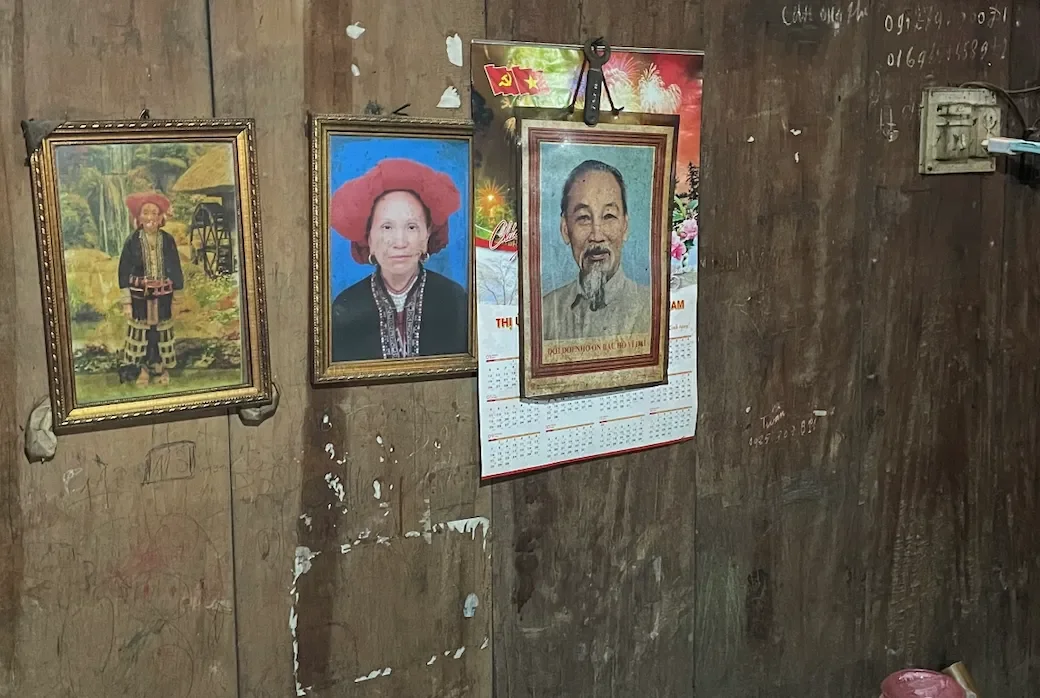
I didn’t go to Vietnam to find God. I went to Vietnam to sit on tiny plastic stools and learn traditional embroidery. Just as well, for Vietnam is an officially atheist state with a population that is reportedly over 75% irreligious. But I couldn’t help seeking out the country’s religion like I sought out little bowls of something unknown and delicious, and in the heavy air of the river-veined Mekong Delta and the thin mist of the Northern mountains, I found divinity in technicolour.
Chau Van Phat, or The Temple of 1000 Buddhas, was my first contact with religion in Vietnam. Standing tall on a side street in Ho Chi Minh City’s second district, the temple was oddly lively for a place of worship. The first three floors held modest altars, leading onto mysterious rooms where my friend and I witnessed both a dog fight and an argument between a group of lay women that seemed to be involved in the running of the temple. We were very annoyed that neither of us could decipher the details of the dispute.
After climbing dingy staircases with spiderwebs caked in brown dust, we opened a door to a grand room glittering with not one thousand, but ten thousand Buddhas. They each sat peacefully in a little box on the wall with a half-smile and delicate pearl skin. In the centre of the room was a much larger Buddha, towering over us on a one thousand-petalled lotus.
My eyes flickered around to take in the maximalism of it all, until they settled on my friend, Clovis. He’s one of the few dedicated, active participants in an organised religion that I know in my generation, and he came to Buddhism some time over a year ago. This was his first time in a Buddhist temple, and I could feel the abbots chanting and the smoking incense swell inside of him. His mouth was agape. It was all very charming and made my eyes sting.
Buddhism came to Vietnam on the backs and lips of Indian monks two millennia ago, around the time the Han Dynasty invaded in 111BC. It spread steadily for a thousand years before becoming the official state religion during the Ly Dynasty. This was short-lived, as Confucianism – first brought in by the Chinese when they started their multi-millennia colonisation of Vietnam in 180BC – took over during the Tran Dynasty of the 13th century.
We think of Confucianism as more of a philosophy than a religion today, but its power to alter a society is as strong, if not stronger, than the pervasive dogmas of religion. Confucianism is a social order. It’s art, education, and sticking strictly to your role. Many of the old temples you’ll stumble across in Vietnam will be Confucianist, recognisable from Chinese characters and distinct statues of Confucius himself. Next time you drive past a school emblazoned with a tagline about learning, growth, and leadership, you know which ancient school of thought to thank. Confucianism sure has its merits, but it’s a conservative and spiritually stifling doctrine – scholar Hieu Tung Ly writes, “the stronger Confucianism is, the weaker Vietnam and her local culture becomes”.
Jump forward to today, and 13.3% of the population is Buddhist, making it the country’s largest religion. It’s followed by Christianity (mainly Catholic), and my personal favourites: Hoa Hoa and Cao Daism. You’d be excused for being unaware of these recently formed syncretic religions, even if you’d spent a fair bit of time in Vietnam. They take up only 1.4% and 1% of the population, respectively. They are, however, one of the most colourful subject matters for anyone interested in the country’s history and cultures.
Syncretic religions take parts of different religions and bring them together to make something new. According to Merriam-Webster’s Encyclopaedia of World Religions, Hoa Hoa reforms Buddhism with elements of ancestor worship, while Cao Daism takes “ethical precepts from Confucianism, occult practices from Taoism, theories of karma and rebirth from Buddhism, and a hierarchical from Catholicism”. Isn’t that just so wonderful? Casting one’s eyes over different religions, selecting various aspects, like carefully selecting each flower from a garden to make a beautiful bouquet. It seems to me that syncretic religions are an enviably scaled example of collective spiritual agency and creativity.
It’s a lovely outlook to have on these religions, but I’ll admit, a deeply rosy-tinted one. Growing up in the UK, it’s hard to imagine the adversity that was needed to meld people together in a communal faith of their own. I discovered that I was in need of an education after a brief conversation with our guide, who took us to a swampy nature reserve close to Can Tho in the Mekong Delta. Her name was Hana, and she was 25, recently engaged, and possessed a bright energy that naturally rose and fell. She introduced me to the epic and uncannily familiar history of Hoa Hoa.
The year is 1920, and Huỳnh Phú Sổ has just been born. Sổ grew up when Vietnam was called another name, Indochina. The French had colonised the country in 1867, but Vietnam was anything but submissive, and local mysticism, folk religion, and occultist spirituality remained strong – along with popular religions like Buddhism, Taoism, and Confucianism. Sổ was a brave but sickly child, so he was sent to the Seven Mountains to live amongst the residing hermits, mystics, and unorthodox Buddhist leaders.
It’s said that in 1939, Sổ descended from the mountains. It was a stormy night, and he preached spontaneously for hours. His inspired words simplified the complex teachings of the Buddha, attracting a large lay crowd. A few medicinal miracles later, and he’d gained disciples who accompanied him as he travelled the region. His political predictions began to come true, like the outbreak of World War II, the fall of French ‘Indochina’ to Japan and France to Nazi Germany – is it any surprise that hundreds and thousands of local peasants pledged their loyalty to him? So was a native Messiah for a people long oppressed, a threat to the colonial powers. He called himself the reincarnation of the Buddha, but as a Western armchair theologian, all I thought when I was reading about him was – Vietnamese Jesus?
There was no cross for Sổ, but rather a mental asylum. He converted his French psychiatrist. They tried to exile him instead, but the second coming was inevitable. In the power vacuum that followed the fall of the Japanese, Sổ ordered the formation of armed units against not just the French, but also local administrative forces and the Vietminh. In 1946, he formed the Viet Nam Democratic Socialist Party, solidifying his position as an all-out troublemaker. But a year later, in 1947, he was executed by the Viet Minh. The tomb door remained unmoving.
You could easily remain oblivious to Hoa Hoa’s military-political history (although, what religion doesn’t have one?), or indeed, oblivious to the religion at all. Without the elaborate temples and religions of Myanmar Buddhism, the religion is only really noticeable to the modern tourist by the ‘global eye’, a symbol that appears on temple windows, altars, and fishing boats. While Hoa Hoa was recognised as an official religion in 1999, this was more of a form of control than a recognition of religious diversity. Anyone who does not follow the state-accepted form of Hoa Hoa faces suspicion and persecution – in 2019, 67 Hoa Hoa followers were placed under house arrest.
Hoa Hoa and Vietnam’s other syncretic religions are just one aspect of the country’s complex cultural diversity. Officially, there are 54 distinct ethnic groups in Vietnam. The Viet people make up the majority at around 87%, and the rest have been split up based on language and location. After spending some time around Sapa in North Vietnam, I found that these lines of distinction are considered reductive and arbitrary by those who are defined by them. 53 ethnic minorities is a vast underestimation. Some are considered to be from the same ethnic group despite speaking entirely different languages.
It was a young girl who offered me this education. I didn’t get her name, but I didn’t need to ask which group she was from because she wore the bright pink checked scarf of the Black Hmong people. She worked in the office of a small tourism company run by a local Hmong woman who had arranged a homestay with a remote Red Dao family for me. From the ceilings hung heavy dresses and robes, weighed down by the heaviness of the embroidery, coins, and shells.
In this mountainous region, you’ll find that much of the population (excluding the many, many tourists) wear the traditional dress of their people, distinct even to the most untrained eye. Sitting in the office, I planted on the Flower Hmong’s dress as my favourite. The minuscule stitches of pink, coral, green, and blue created mouthwatering, melting stripes.
Eventually, the mother of my host family arrived. Her name was May Lai, and she felt much younger than her age of 40 years old. She had a swagger about her. She gave me jelly boots with lotuses on the sides to wear, a bamboo stick, and led me into the mountains for four hours until we reached her mother’s hut. It was too misty to see any views, but May picked indigo from the path’s edge and got me to rub it between my palms until they went green.
I asked her questions and inhaled the answers. Her Red Dao village wasn’t a particularly religious or spiritual place. May Lai didn’t seem much interested in the subject at all. But rituals – rituals were the basis of life in the village. Weddings, for example, are particularly elaborate celebrations. Each one is attended by as many Red Dao as possible. That is, however many are close enough to hear about the wedding and reach it. This is normally somewhere between 500 and 600 people. One bison, ten pigs, and one hundred kilograms of chickens are killed by the guests, who all work together to prepare the meat. It’s a mammoth task, one that May Lai showed me by whipping out TikTok.
This wonderfully juxtaposing act was one that I became familiar with, as I quickly discovered that May Lai loves TikTok. Her home got electricity 10 years ago, and smartphones followed five years later. My first instinct when she opened the app was to bat the phone out of her hands. On our walk so far, I’ll admit that I had romanticised May’s ritualistic lifestyle as a haven untouched by the hyper-modernity that I find so distasteful. Discovering that my newfound perceived oasis had, in fact, already been destroyed by Big Tech was slightly heartbreaking. I did some soul-searching about whether my psyche may need waterproofing against the ‘noble savage’ trope soon after.
Anyway, after scrolling through her fyp for some time, leaning on our bamboo walking sticks, I found that her feed only consisted of other Red Dao. When she scrolled onto a video of a wedding that had taken place 20km down the valley, she said that if it hadn’t been for TikTok, she would have never even known that there were Red Dao in that area at all.
Over 800 people follow May Lai, an impressive feat considering she was raised before the local school opened 20 years ago. So, like many other Red Dao of her generation, she has limited written communication. I helped her write a few WhatsApp messages over my stay, only to watch her navigate TikTok with ease, the stream of sounds from her scrolling becoming a constant comfort like the crackling of the fire. Props to the TikTok UI designers.
Long before TikTok, the first waves of Red Dao began rolling from China to Vietnam in the 12th century. Many settled in Sapa in the 18th century, bringing their traditions with them. While the Black Hmong are known for their bright plaid head scarves, the Red Dao are known for their embroidery. As we were walking, I asked May Lai how long it took her to embroider her outfit. She wore a jacket and wide trousers made of hemp, dyed almost black with indigo, with tiny rows of zigzags in bright orange and green. She replied from ahead of me, stomping unbothered through slick mud, that the trousers must have taken her just over a year and the jacket just over two.
I consider myself to be quite good at embroidery. But when we reached May Lai’s mother’s house – large, open, wooden, and with a central fire that I suppose necessitates the gaps between every plank – I realised that I was not. After I had helped them hold a chicken upside down so they could slit its throat, the blood flowing into a small ornate bowl, they offered me a headtorch. We sat hunched over our hemp for hours, sipping herbal tea and poring over our tiny illuminated needles. This is how May Lai and her mother spend most of their lives. Often more than five hours a day, and still, it takes them years to complete a garment. Any Red Dao engagement must last at least a year because the bride-to-be needs time to complete their outfits.
When I embroider (a rough practice in which I treat the thread more like paint, haphazardly forming miniature portraits of medieval saints), I feel like it’s a devotional act. It’s meditative and totally useless, so it ends up becoming prayer.
Of course, May Lai had already insisted that spirituality of any kind played no part in her family’s lives. They do not need the motivation of faith to dedicate their lives to a futile, time-devouring, and beautiful practice. Tradition, ritual, and beauty – they’re enough in their own right.
Bibliography
Vietnamese Government Committee for Religious Affairs (2023). Cited in the US Office of International Religious Freedom (2023). “Report on International Religious Freedom: Vietnam”. US Department of State.
Haseman, John B. (July–August 1976). “The Hoa Hao: A Half-Century of Conflict”. Asian Affairs: An American Review. 3 (6). Taylor & Francis, Ltd doi:10.1080/00927678.1976.10554207.
“Report of a Home Office fact-finding mission to Vietnam” (PDF). Home Office. 9 September 2019.
