What’s Cool In The Countryside?
Numbers show that more Gen Z are leaving big cities for the countryside. If cities are the breeding grounds for experimentation and culture, what happens to our style when we swap cosmopolitan pavements for rural footpaths?
From Mystic Pizza to Ladybird, coming-of-age movies have been pretty insistent over the decades – interesting people aren’t content in their ‘dead-end’ small towns. Escaping to a city is a rite of passage, one that promises self-discovery and opportunity. It’s a narrative so often solidified, it’s become a simple fact – the countryside is no place for the young, creative, and ambitious.
And yet, numbers show that counterurbanisation – moving from a city to more rural areas – is a rising trend amongst Gen Z. The 2021 Census revealed that young populations in London, Manchester, and Leeds are shrinking. Almost half of London-dwelling 18-24 year olds are planning to move out of the city over the next decade, significantly higher than the 28% of all adults over 18, with 55% basing their decision on high property prices, and 28% on lack of access to the countryside, according to a study in 2023.
“I was getting frustrated with London, with the lack of contact with nature. It felt like I was always hemmed in,” says Minna. With a remote job and a Cornish partner, the 26-year-old was able to move from Deptford to Penzance, Cornwall, two years ago. “The pace of the city became abrasive. I was having to spend so much money to rent and live.” This isn’t an individual problem – Londoners aged 25-29 on low incomes spent 77% of their wages on housing in 2024. It seems only natural, then, that this pressure has left 54% of Gen Z suffering from burnout from work– higher than any other age group. Without money to spend, even the hedonistic work-hard, play-hard city attitude no longer offers a way out. Wiped out, priced out, and the rolling hills of the English countryside start to look a little greener.
Still, cities are the fertile ground for new, innovative modes of self-expression. It was Celia Birtwell’s move from Prestwich to Manchester, uniting her with Ossie Clarke, that allowed the couple to influence how we dress – and view – the female body. What would punk have looked like if Vivienne Westwood had remained in rural Derbyshire? But that isn’t to say that the counterurbanising Gen Z are settling in an environment of bleak creative stagnation. The countryside contributes to fashion in a different way. The Scottish Highlands gave us Chanel’s iconic tweed and Alexander’s McQueen’s ‘Highland Rape’ AW95 collection, and more recently, Pharrell Williams indulged in the influence of countryside dandies and public schoolboys in his SS26 Louis Vuitton pre-collection. The countryside generates inspiration as a muse, and cities are no longer necessary to disseminate these ideas into culture – we can do so with a few taps on our phone.
Take Cottagecore, the aptly named digital aesthetic that romanticizes rural life. It’s a wardrobe of oddly pristine white petticoats, puff sleeves, sweet bows, and empire waistlines, the smell of baked bread wafting from small cottage windows, and a basket of freshly picked wildflowers. Popularised back in 2020, TikTok videos tagged #cottagecore now number 2.1 million. “Maybe the necessity to live outside a city gave birth to the cottagecore spectacle, but the fantasy made people consider the countryside as a long-term option, and made it easier for young people from urban areas to assimilate into rural life.” Dee comments, a 24-year-old culture writer. Dee moved to London to experience life in a multicultural city, but relocated back to their rural home near New Delhi, India, to be in nature and avoid the full-time, corporate lifestyle that’s often necessary to live comfortably in London.
If Cottagecore offers a sanitised rural fantasy, then the latest folk revival is tracking mud over the runway. A fascination for our folk traditions and iconography has bubbled up to the surface of culture once again – look to the nationwide 50th anniversary screenings of folk-horror classic The Wicker Man in 2023, and this year’s record-breaking crowd of 25,000 summer solstice worshippers at Stonehenge. Rising streetwear brands like Heresy have been dressing Gen Z in t-shirts emblazoned with blatant folk iconography. In July, Jeremy Deller’s nationwide performance, ‘The Triumph of Art’, culminated with progressive female morris dancing group Boss Morris parading through Trafalgar Square, accompanied by folkloric wicker characters and dancers dressed as standing stones.
“When I first started telling people that I Morris dance, they would laugh at me in confusion,” says 27-year-old Boss Morris dancer, Jussara. “Being uncool, somehow, is the new cool.” After an upbringing in Lisbon, Jussara is now based in rural Gloucestershire. “I’ve been welcomed with so much love. The lack of funding in the area has resulted in the closure of many third spaces, so we create our own. The spaces that we have aren’t fancy, but it’s the company that matters.”
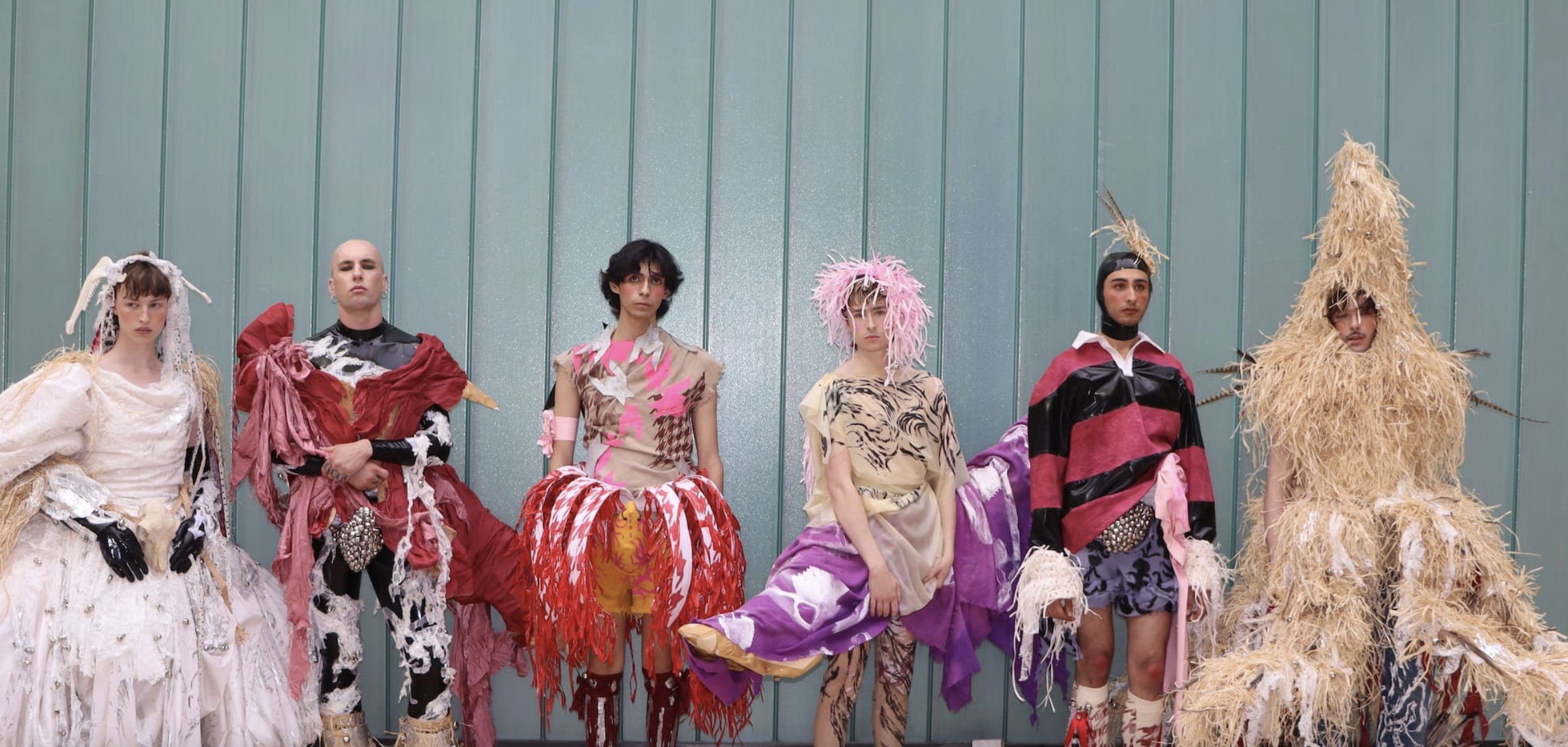
Joe Fearon graduated from Central Saint Martins this year, leaving the university with a collection of sacrificial brides, sheep skulls, latex, and hay stuffing. Titled ‘Nowt So Queer as Folk’, the collection is a culmination of a queer identity and an upbringing in a small northern village, securing Joe as one of three final year Sarabande Scholars. “In my village, we had lost a lot of our folk traditions. We weren’t one of those places with a rich history, straw dollies and things like that,” says Joe, who recalls the only notable surviving tradition, the ‘flower queen’, where a girl is crowned and paraded through the village in a display of flowers and white dresses. “It was very ritualistic and very sweet. Other than that, I had to seek out the esoteric in film, books, and TV.’
Folk horror’s influence is blatant in Joe’s work, never more so than in the sculptural look that sent a life-size ritualistic straw doll down the runway. But their tongue-in-cheek, playful work reflects a wider relaxation towards the rituals of rural English communities. “It’s all very welcoming and inclusive now. It’s not really like the Wicker Man, no one’s getting sacrificed,” they say. “When you actually live in the countryside, you’re not immersed in folk culture every day. But there’s nothing wrong with using it to romanticise life. We’re allowed to fantasise, especially when it comes to fashion.”
Joe Fearon 'Nowt So Queer As Folk'; image courtesy of Leo Kerrigan.
The numbers show that rural fantasies, whether they’re of pagan worship or gingham picnic baskets, are already becoming a reality for many. In the last decade, London has consistently seen more people leave the capital for other places in the UK than vice versa. Remote working is a likely factor – 41% of UK workers currently work from home at least some of the time, compared to 12% before the pandemic – giving many more mobility when deciding where to live. The countryside doesn’t have a reputation for long and varied job boards, but that doesn’t matter to remote workers – naturally, 2.8% of all remote workers, compared to 1.7% of non-remote workers, moved from a city to a rural area between 2018 to 2023.
For Minna, it was her remote position at a digital radio station that allowed her to leave London for the Cornish coast. Rather than being the only 20-something in the county, she found a thriving young population. “There’s so much to do, and different people from all around the world,” she says. Minna first moved to London at 18, and found her friends and style in South London’s post-punk music scene. The move to Penzance spurred another style overhaul. “There’s a trendy population with tiny beanies and chore jackets, and surfer style is a big thing. But your sense of style doesn’t dictate who you’re going to hang out with. I don’t have to wear a tabi shoe to be alternative, so I dress for comfort and practicality,” she explains. “There was a time I went to the office in London wearing a woolen jumper and my Blundstones, and my colleagues said how Cornish I look. It hit me in my soul, like God, I used to be cool.”
Like Minna, Dee found themself wearing experimental outfits in London in order to fit in with a certain group, or stand out and receive some rare attention amongst the crowds. “But in the countryside, people give you attention and intimacy regardless of what you’re wearing,” Dee says. “I don’t have to express myself through personal style. People are interested and want to talk to me, and that affirms my sense of self rather than my style.”
It’s the intimacy of rural communities that has kept 28-year-old Nalani in the countryside for the past six years. Working in a vintage fashion shop in her small town’s high street, she’s been able to find a fashionable community that mashes antique finds from local markets and car boots together with practical country essentials. “I find big populations of young people ostracizing, but if you happen to see another creative person here, it feels exciting instead of intimidating or competitive,” she says. Raised in the South Downs, Nalani chose to return to the countryside after graduating from university. “Every other young person becomes a comrade, like a friendly face in the older crowd.”
Limited access to shops and other young people is in the nature of countryside life. Rather than a hindrance to creativity, Nalani finds it to be a remedy to the paralysis induced by cities and social media. “We don’t always thrive in environments that offer too many options and influence,” she says. “It’s liberating to be limited in some way. I only have charity shops, so my creativity has always been forced by necessity.” Her sentiments are echoed by Meg, a vintage fashion stylist who sources from the few local charity shops and auction houses on the Dorset coast. “When I lived in bigger cities, I was always worrying about being more influenced by other people,” Meg says. “If you’re in the countryside, you know you’re evolving independently.”
Alexander McQueen Autumn/Winter 1995 'Highland Rape' collection; image courtesy of Alexander McQueen.
If this picture of countryside life – unchecked creativity, tight-knit communities, and a monopoly on the trendy items in the charity shop – sounds too good to be true, it’s because for a large portion of Gen Z, it’s out of reach. Poor public transport makes a car, and the constant, substantial expenses that come with it, a necessity, but saving up for one isn’t easy in areas with such few job opportunities. There’s no escape from the renting cycle either – house prices may once have been more affordable, but from 2016 to 2021, average prices in predominantly rural areas increased by 29%, compared with 18% in predominantly urban areas. Rural gentrification and poor infrastructure mean that for many Gen Z, our Areas of Outstanding Beauty are off limits.
“Many young people fantasise about ‘touching grass’ long term,” says Amelie, a Cambridge student who left the southern countryside for university, “But there aren’t enough incentives. Other young people are seasonal fixtures. Jobs are scarce, my friends back home have degrees from good universities, but are struggling to find even minimum wage hospitality work.”
In most cases, there’s only one scenario in which moving to the countryside is actually more affordable and practical – if your family lives there. The number of families with adult children living with their parents rose 13.6% from 2011 to 2021, now nearly reaching 3.8 million. Moving from a city to your childhood bedroom in the countryside is rarely intended to be a permanent solution, turning rural areas into liminal spaces, only endured until enough money is saved for the next adventure. 66% of 18-24 year olds currently living in rural areas are considering leaving within the next year, with a lack of career opportunities (30%) and poor access to services (25%) amongst the top reasons given.
For the members of Gen Z that were more shoved than tempted back to the countryside, the move can have a stifling effect on self-expression and identity. “There are a lot of things that have lost their purpose in my wardrobe,” says Francesca, a 24-year-old who recently moved back in with family in Somerset to save money after studying in London. Isolated from the rave scene that fostered her undergraduate style, Francesca has found that her beloved, daring pieces have become redundant. “People would stare if I dressed how I did in London, but I’m trying not to change how I dress because I know at some point I’m going to be in a place where I can be myself again, and I don’t want to have lost all sense of my style by then.”
Like Francesca, many young people find that there’s no trace of their aligned subculture in the countryside. A diluted young population and a lack of venues mean that many of the niche social groups that thrive in our cities and digital platforms can’t take root in rural areas – and using fashion to signal allegiance to them is futile. Surrounded by people who are illiterate in the subtle fashion cues of our fluctuating micro-cultures, in a place where geographical location is the only factor needed to tie young people together, fashion becomes more about staying warm, dry, and expressing yourself individually than fitting in or standing out amongst a group.
Liberating or isolating, as more of us flock to the countryside, it’s a part of rural life that may not be the same for long.
Lead image: Joe Fearon ‘Nowt So Queer As Folk’; image courtesy of Holly Mckie.
